Safety
Safety testing is a critical step in drug development, assessing whether a drug candidate is non toxic.

Safety testing is a critical step in drug development, assessing whether a drug candidate is non toxic.
Once a drug candidate has been identified and developed, safety and toxicity testing are critical next steps to ensure that no unexpected immune-related adverse events (IrAEs), such as cytokine release syndrome, are induced upon drug treatment.
Drug safety, also known as pharmacovigilance, involves assessing a drug's potential to cause harm. The aim is to identify, understand, and minimize adverse effects before the drug enters human trials. Selecting the appropriate preclinical model is crucial for ensuring that your results are translatable and mimic a human response.
If you have finished in vitro testing of your lead compound and are now seeking the most suitable in vivo preclinical model to evaluate your construct’s safety, genOway is here to support your next steps.



Having comprehensive background information is essential for selecting the right model for your research needs. Additionally, by discussing with us your questions, such as which cells or organs you believe might be affected the most, or feedback loops that might be activated, it allows us to give you better-informed guidance. You can contact us and talk with ourscientific experts — we will be happy to discuss your data to ensure that weprovide you with the most appropriate model for your research.
To help you choose the best model for your safety test, we may ask you some of the following questions:

Relying on wild-type mice or inappropriate humanized models may result in a potentially viable drug candidate being rejected, or important adverse drug reactions not being detected, as occurred in the TeGenero 2006 clinical trial with TGN1412. This can happen when drug safety experiments are performed in PBMC-reconstituted mouse models that do not consider the contribution of myeloid cells to the elicited immune response and which contain a majority of pre-activated T cells.
We have developed a wide range of translational pre-clinical models to meet your research needs, which can be used alone or in complementary ways to maximize and accelerate your research. They are either readily available for purchase (see our Catalog Models) or can be developed specifically for you (see our Customized Models).

Our selection of catalog models includes different types of models useful for safety assessment.
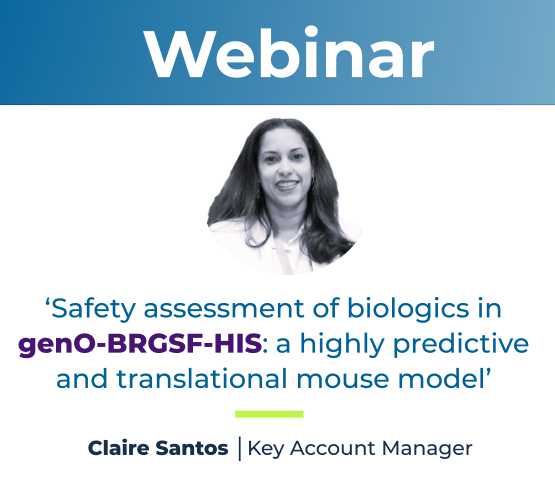
As part of our catalog, we also provide humanized mouse models with a human immune system (HIS), such as the genO-BRGSF-HIS and genO-BRGSF-A2-HIS models. These models are engrafted with human CD34+ hematopoietic stem cells, which provide a much more complete reconstitution of the immune system compared to human PBMCs, thereby making them more translational to clinical studies. Given their functional human myeloid and lymphoid compartments, permissiveness to PDX and CDX engraftments, and extended lifespan, these models are ideal for safety assessment of immunotherapies targeting myeloid and lymphoid cells, as shown in articles published by both Sensei Bio and genOway.
A wide range of target-specific humanized strains is available and ready for purchase. These models are immunocompetent, and display a physiological expression of the human target. Some of the models present in our catalog include:
Another important consideration when performing safety tests for cancer drugs is whether the tumor might impact the drug’s pharmacokinetics or mechanism of action, and whether the activation status of the immune system could also impact the drug’s safety profile. Therefore, if you would like to analyze the safety of your drug in a cancer biology context, our humanized mouse models can be used for syngeneic studies, for which a complementary catalog of cell lines is available.
In our vast portfolio, you can also find immunodeficient rodents. These models can additionally be used for safety assessment in very specific cases. These include analyzing potential on- and off-target effects of CAR-T therapies or testing the safety of gene therapy. Our immunodeficient models support PDX and CDX engraftment and can develop metastasis, as well as allow longer experimental timeframes due to their extended longevity.
If you are looking for a unique model that is not part of our portfolio, we can also make a customized model for you. Our scientists will consider all of your needs and create the best model to fit your research. You can easily book a discussion session and we will guide you through the process.
Our team of scientific experts is here to support you in defining, designing, and optimizing your experiments to ensure the best possible outcomes. You’ll be able to discuss your project with our experienced researchers, who can collaborate with you on your study design, data interpretation, and strategic planning — before, during, and after project execution. We view ourselves as active partners in your research, committed to helping your project succeed.
You can contact us at any moment during the process — we are here to help and willingly dedicate time to you and to your needs.

If you lack the time or facilities to conduct your first proof-of-concept studies, we can discuss whether they can be carried out at genOway using our preclinical platform or by a Contract Research Organization (CRO). Depending on your scientific needs and on the models used, we can assist you in selecting a trusted CRO to conduct your experiments, enabling you to concentrate on advancing your discoveries.



From model design to experimental results
Featured in 600+ scientific articles

Collaboration with 17 Top Pharmas,
170+ Biotechs and 380+ Academic Institutions

Generated with biopharma partners and in-house

and guaranteed freedom to operate

Models with certified health status from professional breeders in US and Europe