FcRn mouse models for antibody pharmacokinetics
Mouse models for PK assessment of therapeutic antibodies: Practical considerations for translational research

Mouse models for PK assessment of therapeutic antibodies: Practical considerations for translational research
Pharmacokinetic (PK) assessment evaluates how long a therapeutic antibody remains in systemic circulation and determines:
What FcRn does
Why species differences matter
Human and mouse FcRn differ markedly in:
As a result: Wild type mice poorly predict human IgG PK; and human FcRn expression is required for translational relevance.
Albumin is a critical FcRn ligand
Consequence: Ignoring albumin biology can distort clearance, half life and candidate ranking.
Humanized FcRn mouse models are used to assess PK of:
Critical distinction: Albumin centric modalities require human albumin expression, not just human FcRn.
Due to the recycling of albumin through theneonatal Fc receptor (FcRn), albumin-binding therapeutic antibodies aredesigned to have a longer half-life. However, when analyzing the half-life ofan albumin-binding antibody in the Tg32 model, the pharmacokinetics (PK)analysis may be misleading due to the lack of human albumin expression andmurine albumin expression instead. Consequently, the antibody will not bindcorrectly to albumin, resulting in inefficient antibody recycling and a shorterhalf-life than predicted.
Key problems in Tg32 model:
Outcome: Wrong candidate can be selected due to model artifact, not true human biology.
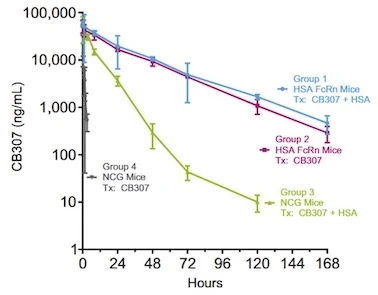
Although WT mice might be useful for initial screening of PK profiles, they do not express human FcRn or human serum albumin. Consequently, when testing therapeutic antibodies designed to bind hFcRn or HAS for extended half-life, WT mouse models with generate inaccurate PK profiles, likely underestimating the half-life of the antibody. This is exemplified in a study by Crescendo Therapeutics, whereby an albumin-binding T cell engager (CB307) tested in WT mice (NCG) has a considerably lower half-life than when testing the TCE in genO-hSA/hFcRn mice (Figure 1) (Archer et al., 2024).
Key problems in WT model:
Outcome: Antibody might be discarded due to misleading reduced half-life.
Antibody pharmacokinetic and half life studies are often initiated in wild type mice, but translational assessment increasingly relies on human FcRn mouse models, including human FcRn transgenic mice such as the Tg32 model and mice expressing both humanized FcRn and human serum albumin, such as the genO-hFcRn/hSA mouse model. These models enable more accurate evaluation of FcRn dependent clearance and improved prediction of human IgG pharmacokinetics (Viuff et al., 2016; Roopenian and Akilesh, 2007; Fuchs et al., 2022).
Among FcRn mouse models, Tg32 mice expressing human FcRn on a mouse FcRn null background have long served as a reference model for antibody pharmacokinetics; however, their reliance on murine albumin limits the physiological relevance of FcRn occupancy and ligand competition. In contrast, genOway’s genO hSA/hFcRn model, which co expresses human FcRn and human serum albumin, more faithfully reproduces human FcRn biology by capturing the competitive recycling of IgG and albumin and by normalizing FcRn engagement across both ligands, thereby improving prediction of human antibody half life and clearance compared with Tg32 and other single humanized models (Viuff et al., 2016; Christianson et al., 2026; Lee et al., 2025).
Humanized FcRn mouse models allow monoclonal antibodies to engage human FcRn in vivo, enabling accurate assessment of Fc mediated recycling and clearance mechanisms that are not faithfully captured in wild type mice due to species specific FcRn binding differences (Roopenian and Akilesh, 2007; Pyzik et al., 2023).
Traditional wild type mouse models are limited by the fact that murine FcRn binds human IgG with different affinity and kinetics than human FcRn, leading to systematic overestimation of antibody half life and poor translational accuracy for human pharmacokinetic prediction (Roopenian and Akilesh, 2007).
Human FcRn mouse models improve antibody half life prediction by reproducing the pH dependent interaction between the human IgG Fc domain and human FcRn, allowing in vivo clearance rates to more closely reflect those observed in clinical studies (Fuchs et al., 2022; Mackness et al., 2019).
FcRn functions as an intracellular salvage receptor that binds IgG in acidic endosomes after nonspecific uptake, protects it from lysosomal degradation, and returns it to the circulation where IgG is released at neutral pH (Roopenian and Akilesh, 2007).
FcRn regulates IgG half life through the efficiency of pH selective binding, such that increased affinity at acidic pH enhances recycling and prolongs serum persistence, whereas reduced or improperly tuned binding accelerates lysosomal degradation and clearance (Roopenian and Akilesh, 2007; Mackness et al., 2019).
FcRn is central to therapeutic antibody pharmacokinetics because it governs systemic exposure, dosing interval, and the success of Fc engineering strategies designed to extend antibody half life in cancer, autoimmune, and inflammatory diseases (Pyzik et al., 2023).
Amino acid differences at the FcRn–Fc interface and subclass specific binding disparities between mouse and human FcRn result in altered recycling efficiencies, explaining why human IgG half life is misrepresented in wild type mice (Roopenian and Akilesh, 2007).
Albumin recycling is important because FcRn also rescues albumin from intracellular degradation, and competition between albumin and IgG for FcRn binding influences receptor occupancy, antibody clearance, and the pharmacokinetics of Fc fusion and albumin binding therapeutics (Pyzik et al., 2023).
Fc engineered antibodies are tested in vivo by comparing their pharmacokinetic profiles to wild type Fc antibodies in human FcRn transgenic mice, where improved or impaired half life directly reflects changes in FcRn binding properties (Mackness et al., 2019; Ko et al., 2022).
Antibody recycling in mouse models is measured through longitudinal serum pharmacokinetic analysis, comparison with FcRn knockout mice, tissue distribution studies, and tracer based approaches that assess FcRn dependent intracellular rescue (Bryniarski et al., 2024).
FcRn mouse models aid human pharmacokinetic prediction by enabling quantitative scaling of clearance and half life based on human relevant FcRn interactions, often achieving predictive accuracy comparable to that of non human primates (Haraya et al., 2025; Christianson et al., 2026).
Preclinical models used to study FcRn mediated drug recycling include human FcRn transgenic mice such as Tg32, human FcRn knock in mice, FcRn deficient mice for mechanistic validation, and complementary in vitro FcRn binding and recycling assays (Roopenian and Akilesh, 2007; Pyzik et al., 2023).
FcRn engages albumin and IgG through separate, non‑overlapping binding interfaces, and interaction with either ligand occurs in a pH‑dependent manner, being restricted to acidic conditions below pH 6.5 and absent at neutral pH (Chaudhury et al., 2006; Andersen et al., 2006)



From model design to experimental results
Featured in 600+ scientific articles

Collaboration with 17 Top Pharmas,
170+ Biotechs and 380+ Academic Institutions

Generated with biopharma partners and in-house

and guaranteed freedom to operate

Models with certified health status from professional breeders in US and Europe