
Other scientific insights
Humanized FcRn and serum albumin (hSA/hFcRn) mouse models: advancing translational pharmacokinetics of biologics
9 min read
June 18, 2026
A defining feature of modern biologics development is the need to accurately predict human pharmacokinetics (PK) early in preclinical pipelines. Central to this challenge is the neonatal Fc receptor (FcRn), a key regulator of IgG and albumin homeostasis that governs systemic exposure, biodistribution and half life of a broad range of therapeutics. FcRn protects immunoglobulin G (IgG) and serum albumin (SA) from lysosomal degradation through a pH dependent recycling pathway, extending their half life to approximately 19–23 days in humans (Andersen and Sandlie, 2009). This biological axis has been widely exploited for therapeutic engineering, yet its intrinsic species specificity remains a major obstacle to translational PK assessment (Andersen and Sandlie, 2009; Andersen et al. 2014).
Species-specific FcRn biology and its impact on PK
FcRn biology differs significantly across species at genetic, structural and functional levels, with direct consequences for ligand binding and recycling efficiency (Ortiz-Alegría et al., 2025, Van Damme et al., 2026). A well documented example is the interaction between human serum albumin (HSA) and FcRn: HSA binds efficiently to human FcRn but exhibits markedly reduced or negligible affinity for murine FcRn. Conversely, human IgG can display artificially high affinity for mouse FcRn, leading to prolonged half life in wild type rodents compared with humans (Conner et al., 2023; Merten et al., 2021). These interspecies discrepancies distort clearance, distribution and exposure profiles, ultimately limiting the predictive value of conventional mouse models. As a result, reliance on such systems can lead to under- or over-estimation of dosing regimens in the clinic.
Humanized FcRn models: improving translational relevance
To address these limitations, humanized FcRn mouse models have emerged as critical translational tools. By replacing murine FcRn with its human counterpart, these models enable more physiologically relevant PK readouts for human IgG based therapeutics. Notably, studies using hFcRn transgenic mice have demonstrated robust correlations between murine and human half life and clearance parameters for monoclonal antibodies (mAbs), with most predictions falling within a two- to three fold range of clinical values (Nakamura et al., 2021). Similarly, next generation models engineered via targeted knock in strategies ensure tissue appropriate expression of hFcRn, maintaining physiological control of recycling pathways and improving model fidelity.
Beyond FcRn: the need for dual humanization with human serum albumin
However, FcRn humanization alone does not fully resolve translational gaps, particularly for albumin based or albumin binding therapeutics. Because murine serum albumin (MSA) and human serum albumin (HSA) differ in their affinity for FcRn, they compete differently for FcRn mediated recycling in mice and humans. Consequently, humanized FcRn mice that retain murine albumin may not accurately reproduce the recycling and pharmacokinetics of albumin associated therapies. Humanization of both the FcRn receptor and the albumin ligand is therefore often required to more faithfully model human albumin turnover and drug pharmacokinetics. This has led to the development of a dual humanized SA/FcRn mouse model by genOway, the genO-hSA/hFcRn model, which expresses humanized FcRn under endogenous promoter, ensuring tissue specific expression, combined with knock in of HSA to reproduce physiological serum albumin levels, enabling a more faithful recapitulation of the human albumin-FcRn recycling system (Viuff et al., 2016). In this system, physiological expression of HSA alongside hFcRn restores native ligand competition and stabilizes systemic protein turnover, providing a more predictive context for evaluating half life extension strategies. These advances have significantly reduced the dependence on non human primates while increasing throughput and ethical acceptability.
Predictivity and translational evidence of the genO-hSA/hFcRn model
Recent data further underscore the translational relevance of these systems. PK curves generated in genO-hSA/hFcRn transgenic mice have shown strong concordance with human exposure profiles for therapeutics such as antibody-drug conjugates (ADCs) (figure 1). Thanks to the combined HSA expression, these mice extend the predictive capacity to albumin fusions and half-life extended biologics, enabling early identification of candidates with optimal PK characteristics. Such datasets highlight the capacity of dual humanized models not only to rank candidates but also to predict human like elimination kinetics.
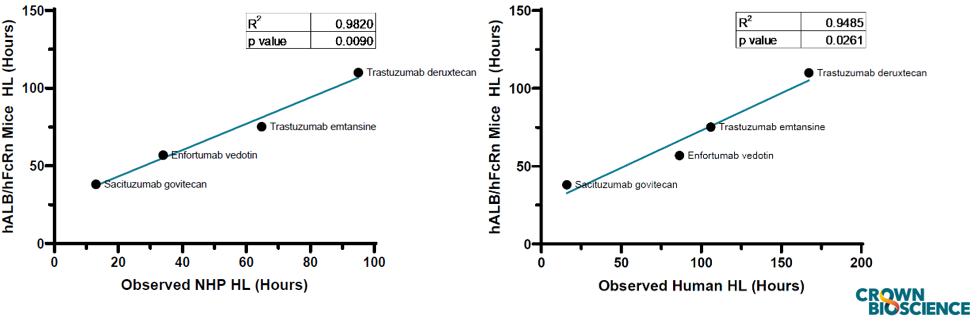
An additional strength of this model lies in its versatility through intercross upgrades. genO-hSA/hFcRn mice can be combined with other humanized backgrounds, such as the genO-hFcγR model or the genO-hTFRC, or immunodeficient strains, to create tailored solutions for specific therapeutic modalities. For instance, the genO-hFcγR/hFcRn mouse model expresses the whole repertoire of human Fcγ receptors (Van Damme et al, 2026) enabling the simultaneous analysis of half-life and effector functions of new therapeutic antibodies. Such combinatorial approaches expand the translational landscape beyond PK into pharmacodynamics and efficacy studies.
Conclusion: bridging the preclinical-clinical gap
In conclusion, the species specific nature of FcRn biology necessitates the use of advanced humanized models for accurate PK assessment. Dual humanization of serum albumin and FcRn represents a critical step forward, enabling physiological modelling of both IgG and albumin recycling pathways. By integrating controlled gene expression, modular design, and demonstrated predictive performance, genOway’s models provide a powerful platform for the preclinical evaluation of next generation biologics, bridging the gap between rodent studies and human clinical outcomes.
References
Andersen, J.T., Sandlie, I. (2009). The versatile MHC class I related FcRn protects IgG and albumin from degradation: implications for development of new diagnostics and therapeutics. Drug Metabolism and Pharmacokinetics.
Andersen, J.T. et al. (2014). Extending serum half life of albumin by engineering neonatal Fc receptor binding. Journal of Biological Chemistry.
Conner, C.M. et al. (2023). A precisely humanized FCRN transgenic mouse for preclinical pharmacokinetics studies. Biochemical Pharmacology.
Feng, X. et al (2026). Enhancing the Predictability of Human Pharmacokinetics for Antibody-Drug Conjugates Using Human FcRn Transgenic Mice. AACR 2026 poster.
Merten, H. et al. (2021). Half life extension of DARPin serum albumin fusions as a function of FcRn affinity. European Journal of Pharmaceutics and Biopharmaceutics.
Nakamura, G. et al. (2021). Prediction of human pharmacokinetics profile of monoclonal antibody using hFcRn transgenic mouse model. Biological and Pharmaceutical Bulletin.
Ortiz Alegría, L.B. et al. (2025). The FcRn from gene to protein and function: comparison between species. Frontiers in Immunology.
Van Damme K.F.A. et al. (2026) Cross-species cellular mapping and humanization of Fcγ receptors to advance antibody modeling. Sci. Immunol.11,eady7328.
Viuff, D. et al. (2016). Generation of a double transgenic humanized neonatal Fc receptor (FcRn)/albumin mouse to study the pharmacokinetics of albumin linked drugs. Journal of Controlled Release, 223, 22–30.
Related products
Catalogue product
Customized product
No items found.

Scientific excellence
From model design to experimental results
Featured in 600+ scientific articles

Collaborative approach
Collaboration with 17 Top Pharmas,
170+ Biotechs and 380+ Academic Institutions

Robust validation data on catalog models
Generated with biopharma partners and in-house

Innovative technologies
and guaranteed freedom to operate

Easy access to models
Models with certified health status from professional breeders in US and Europe