.avif)


その他の科学的知見
ネズミの話に戻ろう!
読了時間:2分
2021年8月17日
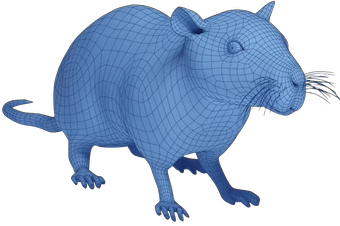
20世紀の最後の30年間、ラットは生物医学研究、とりわけ心血管および行動神経科学の研究において「王者」としての地位を占めていた。その後、ゲノム工学が登場し、マウスがその座を奪った。1980年代初頭、主に生殖細胞系列形成能を持つラットの胚性幹細胞(ES細胞)の作製が困難であったため、トランスジェニックマウスの作製はラットよりも確かに容易であった。 したがって、1981年に最初のトランスジェニックマウスモデルが作出された当時、ラットにおいて恒常的(constitutive)またはコンディショナル な遺伝子のノックアウト、ノックイン、あるいは部位特異的突然変異誘導がまだ利用可能でなかったことは、驚くことではない。ES細胞を直接操作しない、アンチセンスRNA、RNA干渉、化学的突然変異誘導といった他の技術の開発のおかげで、最初のトランスジェニックラットがようやく登場したのは、それからさらに9年後のことだった。1

しかし、真の「ラット革命」が起こったのは、2012年にCRISPR/Cas9が登場したときであった。これにより、科学者は哺乳類の受精卵内の任意の配列を直接標的とすることが可能となり、従来の相同組換え技術を用いてトランスジェニック動物を作出するために必要だった、ES細胞の操作という長期間を要するプロセスが不要となった。それ以来、特にラット固有の特性がモデル動物としての適性を高める幅広い研究分野において、数多くのラットモデルが開発されてきた。2
例えば、ラットは、薬物代謝や薬物動態、さらには心血管疾患、神経疾患、代謝性疾患の研究において優れた動物モデルとなります。その大きさ(ラットはマウスよりも10倍大きい)により、より大きな組織量からの複数回のサンプリング、脳への化合物のより精密な注入、そしてより容易な顕微外科手術が可能になります。1,3,4また、ラットはマウスよりもはるかに社会性が高く、その行動が人間の行動に非常に似ているため、行動神経科学における重要なモデル生物でもあります。最後に、ラットは、免疫やフェロモンの産生に関与する遺伝子を含め、ヒトには存在するがマウスには存在しない遺伝子の役割を解明するための有用なツールとしても機能します。5
こうして、ラットは本来あるべき栄誉ある地位を取り戻し、特に特定の研究分野において、生物医学研究の最前線に再び立ち戻った。したがって、研究者は技術的な制約に縛られることなく、対象となる生物学的特性や、研究対象となる特定のプロセスや遺伝子に基づいて、マウスかラットのいずれが最も適切なモデルであるかを選択することができるようになった。
参考文献:
- 遺伝子組み換えラットモデルの作製への応用。Front Genet. 2021;12:615491. doi:10.3389/fgene.2021.615491
- Meek S、Mashimo T、Burdon T. 「ラットゲノムの工学的研究から編集へ」。Mamm Genome. 2017;28(7-8):302-314. doi:10.1007/s00335-017-9705-8
- Lu J、Liu J、Guo Y、Zhang Y、Xu Y、Wang X. CRISPR-Cas9:薬物代謝および薬物動態のラットモデルを構築するための手法。『Acta Pharmaceutica Sinica B』 2021年1月オンライン公開:S2211383521000113. doi:10.1016/j.apsb.2021.01.007
- Blais EM、Rawls KD、Dougherty BV、他。比較トキシコゲノミクスおよびバイオマーカー予測のための、ラットとヒトの代謝ネットワークの統合。Nat Commun.2017;8(1):14250. doi:10.1038/ncomms14250
- ラットゲノム解読プロジェクト・コンソーシアム. ブラウン・ノルウェーラットのゲノム配列が哺乳類の進化に関する知見をもたらす.Nature. 2004;428(6982):493-521. doi:10.1038/nature02426
関連商品
カタログ掲載商品
オーダーメイド製品

卓越した科学
モデル設計から実験結果まで
600件以上の科学論文で取り上げられています

協調的なアプローチ
大手製薬企業17社、
、170社以上のバイオテクノロジー企業、および380以上の学術機関との提携

カタログモデルに関する信頼性の高い検証データ
バイオ医薬品分野のパートナー企業および 社内リソースを用いて生成

革新的な技術
および実施の自由が保証される

モデルへの容易なアクセス
米国および欧州の専門ブリーダーから、健康状態が認定された個体