


Affiches associées
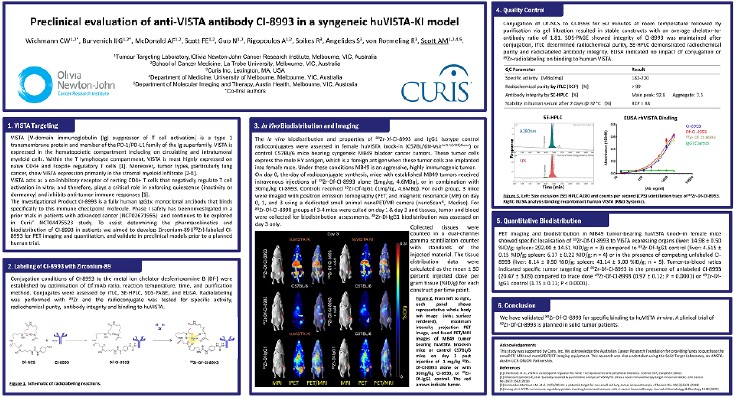
(Sensei) Antagonistic pH-selective VISTA antibody potentiates anti-PD-1/PD-L1-induced anti-tumor immunity
VISTA and PD-1 signaling in the tumor microenvironment
SITC 2021
15 novembre 2021
Introduction
Immunotherapies, especially immune checkpoint inhibitors, are a cornerstone of cancer treatment. Remarkable clinical responses have been observed blocking the programmed cell death protein 1 (PD-1)/programmed death-ligand 1 (PD-L1) axis across a spectrum of indications. However, innate and/or acquired resistance to anti-PD-1 blockade remains a major challenge. V-domain Ig suppressor of T-cell activation (VISTA) is a B7-family member, which promotes T-cell and myeloid quiescence and represents a promising target, particularly in combination with anti-PD-1/PD-L1 treatment¹˒². Recently, the interaction of VISTA with its receptor PSGL-1 was demonstrated to be significantly enhanced by the acidic tumor microenvironment (TME)³. As VISTA is highly expressed on myeloid cells, including those in the blood, antibodies binding VISTA at physiological pH 7.4 (VISTAᵖᴴ) could result in rapid elimination from circulation through target-mediated drug disposition (TMDD), making efficacious drug occupancy levels difficult to reach and potentially narrowing the therapeutic window. A pH-non-selective clinical molecule (JNJ-61610588) exhibited TMDD and induced dose-limiting on-target cytokine release syndrome (CRS) at subtherapeutic dose levels. An antibody engineered to selectively bind and block VISTA at low pH in the TME (VISTAˡᵖᴴ) may therefore be required as an anti-VISTA drug candidate.


Excellence scientifique
De la conception du modèle aux résultats expérimentaux
Cité dans plus de 600 articles scientifiques

Approche collaborative
Collaboration avec 17 grands laboratoires pharmaceutiques,
plus de 170 entreprises biotechnologiques et plus de 380 établissements universitaires

Données de validation fiables sur les modèles du catalogue
Élaborées en collaboration avec des partenaires du secteur biopharmaceutique et en interne

Technologies innovantes
et la garantie de la liberté d'exploitation

Accès facile aux modèles
Modèles avec certificat sanitaire provenant d'éleveurs professionnels aux États-Unis et en Europe