.avif)


その他の科学的知見
第2部:BRGSF――免疫腫瘍学研究のための新たな免疫不全モデル
読了時間:6分
2020年3月17日
前回の解説で述べたように、マウスは前臨床研究において主要な実験モデルとなっています。これは、疾患の病因の解明や治療法の評価を行う上で、費用対効果が高く、繁殖が早く、飼育が容易な哺乳類モデルであるためです。1,2同系腫瘍移植や遺伝子改変マウスモデルは、免疫調節の基本的なメカニズムについて多大な知見をもたらしてきました。 しかし、長年にわたり、ヒトとマウスとの間に存在する著しい遺伝的およびゲノム的な差異が、感染症や免疫関連疾患における実験結果の臨床応用を妨げており、その結果、臨床試験の失敗につながることが非常に多い。3,4
このギャップを埋め、in vitroおよびマウスを用いた研究から臨床応用への知識の移転を促進するため、科学者たちは、SCID、NUDE、Rag欠損マウスなど、さまざまな免疫不全モデルを作成し、これらに細胞由来異種移植片(CDX)または患者由来異種移植片(PDX)を皮下または同所的に移植してきた。5,6
NUDEマウスは、毛がないため皮下に容易に移植できることから、主にがんの発生と進行の研究に使用された。 一方、SCIDマウスやRag欠損マウスは、NUDEマウスよりも免疫不全度が高く(すなわち、T細胞とB細胞の両方が欠如している)、リンパ腫、骨髄腫、白血病などの血液がんの研究に最適な宿主であった。5しかし、これらのモデルはすべて、残留するマウス由来の免疫細胞を有していたため、長期の異種移植研究には使用できなかった。 さらに、機能的な免疫系の欠如は、腫瘍発生の病態生理や免疫系からの逃避メカニズムを適切に理解すること、および効果的な抗腫瘍反応を誘導する免疫療法を評価する上で、大きな懸念事項となっていた。2,7
こうした理由から、科学者たちは、SCIDマウスおよびRag欠損マウスを非肥満性糖尿病(NOD)マウスまたはBalb/cマウスにバッククロスさせることで、新世代の高度免疫不全マウスを開発しました。 その結果得られた系統であるNOG(NOD/Shi-scid IL-2rγnull)、NSG(NOD-scidIL-2rγ−/−)、およびBRGS(Balb/cRag2tm1FwaIL-2rγtm1CgnSirpαNOD)は、以下の複数の遺伝的欠損を有している。i) IL-2受容体の共通γ鎖(IL-2rγ)における変異(これにより重度のNK細胞欠損が生じる)、ii) Prkdc(NOGおよびNSG)またはRag2(BRGS)における変異(これによりB細胞およびT細胞の減少が生じる)、ならびにiii) NOD特異的なSirpαの多型であり、これによりマウスマクロファージによるヒトCD47+細胞の貪食能が低下する(すなわち、「私を食べないで」シグナル)。8–11
NOGおよびNSGは、NUDEマウスやSCIDマウスと比較してヒト組織の生着率が優れているため、PDX研究で広く用いられてきた。しかし、Prkdc遺伝子の変異により、これらの系統はSCID特有の副作用である放射線に対する高い感受性、 T細胞の漏出、および胸腺リンパ腫の発生率上昇といったSCID特有の副作用を示す。そのため、特定の抗がん剤に対する臨床的反応を予測したり、長期移植研究に用いたりすることはできない。12,13BRGSはPrkdc変異を持たないため、NSGおよびNOG系統で観察されるSCID表現型を示さず、これら両方の問題を解決している。9,10
BRGSは最近、パスツール研究所の科学者チームによって、BRGF(BALB/cRag2tm1FwaIl2rγtm1CgnFlt3tm1lrl)系統へのバッククロスを行うことで改良されました。 その結果得られたBRGSF(BALB/cRag2tm1FwaIl2rγtm1CgnSirpαNODFlt3tm1lrl)は、親系統の遺伝的欠陥を継承していることに加え、骨髄系細胞群の発達を調節する胎児肝キナーゼ-2(Flk2)の欠損も有しているため、高度な免疫不全を呈している。14–16
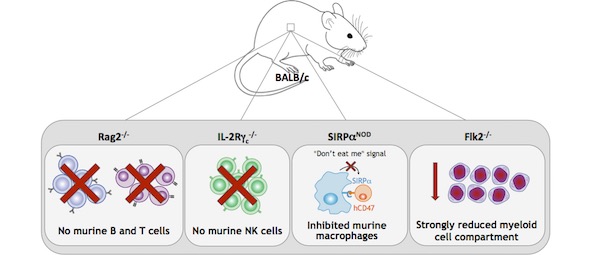
こうした理由から、BRGSFマウスモデルは、ワクチン開発、キメラ抗原受容体(CAR)T細胞療法の有効性および安全性、ならびに骨髄系細胞群の発達に関する研究において、貴重なツールとなっています。さらに、BRGSFはヒト造血細胞の生着に対して非常に寛容であるため、ヒト免疫系(HIS)マウスを作出し、ヒトの免疫応答を研究・予測するための最適なモデルとなっています in vivo.8,14–16
関連項目:
第1部:免疫腫瘍学における、より優れた有効な前臨床モデルを目指して
第3部:免疫腫瘍学研究のための新しいヒト免疫系マウスモデル「BRGSF-HIS」
第4部:免疫腫瘍学研究のためのヒト化免疫チェックポイントマウスモデル
第5部:PK/PD研究に最適な強力なモデル「HSA/hFcRn」
参考文献:
- Wagar, L. E.; DiFazio, R. M.; Davis, M. M. 「基礎およびトランスレーショナルヒト免疫学のための先進的なモデルシステムとツール」。Genome Med.2018, 10 (1), 73. https://doi.org/10.1186/s13073-018-0584-8.
- Wege, A. K. 「がん免疫療法の非臨床評価のためのヒト化マウスモデル」。BioDrugs Clin. Immunother. Biopharm.Gene Ther. 2018, 32 (3), 245–266. https://doi.org/10.1007/s40259-018-0275-4.
- Bedognetti, D.; Ceccarelli, M.; Galluzzi, L.; Lu, R.; Palucka, K.; Samayoa, J.; Spranger, S.; Warren, S.; Wong, K.-K.; Ziv, E.; et al. がんの免疫応答性に関する包括的見解に向けて:SITCワークショップの概要。J. Immunother. Cancer 2019, 7 (1), 131. https://doi.org/10.1186/s40425-019-0602-4.
- Attarwala, H. 「TGN1412:発見から大惨事まで」。J. Young Pharm. 2010, 2 (3), 332–336. https://doi.org/10.4103/0975-1483.66810.
- Allen, T. M.; Brehm, M. A.; Bridges, S.; Ferguson, S.; Kumar, P.; Mirochnitchenko, O.; Palucka, K.; ペランダ, R.; サンダース=ビア, B.; シュルツ, L. D.; ほか. ヒト化免疫系マウスモデル:進展、課題、そして可能性.Nat. Immunol. 2019, 20 (7), 770–774. https://doi.org/10.1038/s41590-019-0416-z.
- Yong, K. S. M.; Her, Z.; Chen, Q. 「ヒト特異的研究のための独自のツールとしてのヒト化マウス」。Arch. Immunol. Ther. Exp. (Warsz.) 2018, 66 (4), 245–266. https://doi.org/10.1007/s00005-018-0506-x.
- Perlman, R. L. 「ヒト疾患のマウスモデル:進化的視点」。Evol. Med. Public Health 2016, 2016 (1), 170–176. https://doi.org/10.1093/emph/eow014.
- Simpson, J. A.; Brown, M. E. 「HISマウスをよりヒトに近づける」。J. Leukoc. Biol. 2020, 107 (1), 9–10. https://doi.org/10.1002/JLB.5CE1019-262R.
- 山内 哲也;竹中 健;浦田 聡;島 哲也;菊重 陽子;徳山 哲也;岩本 智子;西原 真;岩崎 弘;宮本 哲也; 他. 多型性を示すSirpαは、NOD系マウス系統においてヒト細胞の効率的な生着を実現するための遺伝的決定因子である。Blood 2013, 121 (8), 1316–1325. https://doi.org/10.1182/blood-2012-06-440354.
- Lopez-Lastra, S.; Di Santo, J. P. 「ナチュラルキラー細胞を標的とした免疫療法のモデル化」。Front. Immunol. 2017, 8. https://doi.org/10.3389/fimmu.2017.00370.
- Zitvogel, L.; Pitt, J. M.; Daillère, R.; Smyth, M. J.; Kroemer, G. 「腫瘍免疫学におけるマウスモデル」.Nat. Rev. Cancer 2016, 16 (12), 759–773. https://doi.org/10.1038/nrc.2016.91.
- Pearson, T.; Shultz, L. D.; Miller, D.; King, M.; Laning, J.; Fodor, W.; Cuthbert, A.; Burzenski, L.; Gott, B.; ライオンズ, B.; 他. 非肥満性糖尿病-組換え活性化遺伝子-1 (NOD-Rag1 ノックアウト) インターロイキン (IL)-2 受容体共通γ鎖 (IL-2Rγ ノックアウト) ノックアウトマウス:ヒトリンパ造血組織移植のための放射線抵抗性モデル。Clin. Exp. Immunol. 2008, 154 (2), 270–284. https://doi.org/10.1111/j.1365-2249.2008.03753.x.
- Fulop, G. M.; Phillips, R. A. マウスのScid変異は、DNA修復における全般的な欠陥を引き起こす。Nature 1990, 347 (6292), 479–482. https://doi.org/10.1038/347479a0.
- Lopez-Lastra, S.; Masse-Ranson, G.; Fiquet, O.; Darche, S.; Serafini, N.; Li, Y.; Dusséaux, M.; Strick-Marchand, H.; ディ・サント, J. P. 機能的なDC間のクロストークがヒト化マウスにおけるヒトILCの恒常性を促進する。Blood Adv. 2017, 1 (10), 601–614. doi.org/10.1182/bloodadvances.2017004358
- Li, Y.; Mention, J.-J.; Court, N.; Masse-Ranson, G.; Toubert, A.; Spits, H.; Legrand, N.; Corcuff, E.; Strick-Marchand, H.; Di Santo, J. P. ヒト樹状細胞(DC)の分化が選択的に促進される新規Flt3欠損HISマウスモデル。Eur. J. Immunol. 2016, 46 (5), 1291–1299. https://doi.org/10.1002/eji.201546132.
- Legrand, N.; Huntington, N. D.; Nagasawa, M.; Bakker, A. Q.; Schotte, R.; Strick-Marchand, H.; de Geus, S. J.; Pouw, S. M.; ボーネ, M.; フォールドウ, A.; 他. ヒトT細胞およびナチュラルキラー(NK)細胞の最適な恒常性維持には、機能的なCD47/シグナル調節タンパク質α(SIRPα)間の相互作用が必須であるin Vivo.Proc. Natl. Acad. Sci. 2011, 108 (32), 13224–13229. https://doi.org/10.1073/pnas.1101398108.

卓越した科学
モデル設計から実験結果まで
600件以上の科学論文で取り上げられています

協調的なアプローチ
大手製薬企業17社、
、170社以上のバイオテクノロジー企業、および380以上の学術機関との提携

カタログモデルに関する信頼性の高い検証データ
バイオ医薬品分野のパートナー企業および 社内リソースを用いて生成

革新的な技術
および実施の自由が保証される

モデルへの容易なアクセス
米国および欧州の専門ブリーダーから、健康状態が認定された個体