


同系マウスモデル

読了時間:3分
2020年4月9日

Cancer research, especially anticancer drug discovery, relies on animal models that have been, and are still being, optimized. Mouse and rat models are broadly used to recapitulate tumor development, microenvironment, and for some the accompanying immune response.

Today, scientists can access several preclinical models in cancer research such as cell line transplantation models, patient-derived xenografts, genetically engineered mouse models, human immune system mouse models, and humanized immune-checkpoint mouse models.

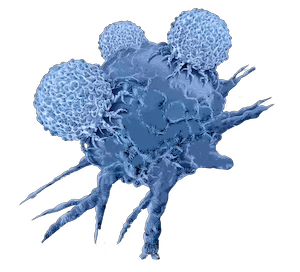
Syngeneic models are transplantation models obtained by injecting a recipient of a specific genetic background with cell lines previously established through isolation of tumor cells from a mouse of the same genetic background.

The advantage of syngeneic models is that the transplanted cells, the tumor microenvironment, and the host are from the same strain, making this model particularly relevant when studying the process of metastasis.

Different cell lines have been developed in syngeneic models, mostly in the C57BL/6 and Balb/c background. These cells have different features that must be taken into account when choosing your syngeneic model of interest, including:

  • Tumor origin (colon, breast, lung, etc.)
  • Genetic background (Balb/c mice are known to favor stronger humoral responses than C57BL/6)
  • Immunogenicity (for example, B16/F10 cells are less immunogenic and thus more resistant to ICP blockade treatment)

A syngeneic model can be optimized for a specific application and study by carefully choosing the cell line used.

Genetically optimizing syngeneic models

Classical syngeneic models show only murine interactors. These models can be optimized for a specific application by genetically “humanizing” a target of interest in the recipient mouse or tumor cells.

For example, we have generated a catalog of mice harboring human immune checkpoint targets such as PD‑1, CTLA‑4 and VISTA. We also generated MC38 cells expressing human PD-L1 and not mouse Pd-l1.

In addition to this catalog, we have optimized our gene-editing platforms to provide on-demand relevant models for immuno-oncology studies.

関連商品

カタログ掲載商品

genO-hPD-1

genO-hPD-1マウスは、完全な免疫能を有するマウスにおいて、ヒト免疫チェックポイントPD-1を標的とする化合物の生体内での有効性評価およびプロファイリングを可能にする

genO-hVISTA

genO-hVISTAマウスは、完全な免疫能を有するマウスにおいて、ヒト免疫チェックポイントVISTAを標的とする免疫腫瘍学薬剤のin vivo有効性評価およびプロファイリングを可能にします。

genO-hCTLA-4

genO-hCTLA-4マウスを用いることで、免疫機能が完全に保たれたマウスにおいて、ヒトの免疫チェックポイントであるCTLA-4を標的とする薬剤の生体内での有効性評価およびプロファイリングが可能となる。

genO-MC38-hPD-L1-LZ

genO-MC38-hPD-L1-LZクローン細胞株は、ヒトPD-L1を高発現し、 in vivoにおいて固形腫瘍を形成する。また、ルシフェラーゼ-ZsGreen(LZ)融合タンパク質の最適化版も、 in vivo イメージングおよびex vivo追跡のために、最適化されたルシフェラーゼ-ZsGreen(LZ)融合タンパク質も安定発現している。

オーダーメイド製品

該当する項目はありません。
その他の解説
卓越した科学

モデル設計から実験結果まで
600件以上の科学論文で取り上げられています

協調的なアプローチ

大手製薬企業17社
、バイオテクノロジー企業170社以上、および学術機関380機関以上との提携

カタログモデルに関する信頼性の高い検証データ

バイオ医薬品パートナー企業および 社内チームと共同で作成

革新的な技術

および実施の自由が保証される

モデルへの容易なアクセス

米国および欧州の専門ブリーダーから、健康状態が認定された個体